Voices of Experience
What we heard at our Open Forums
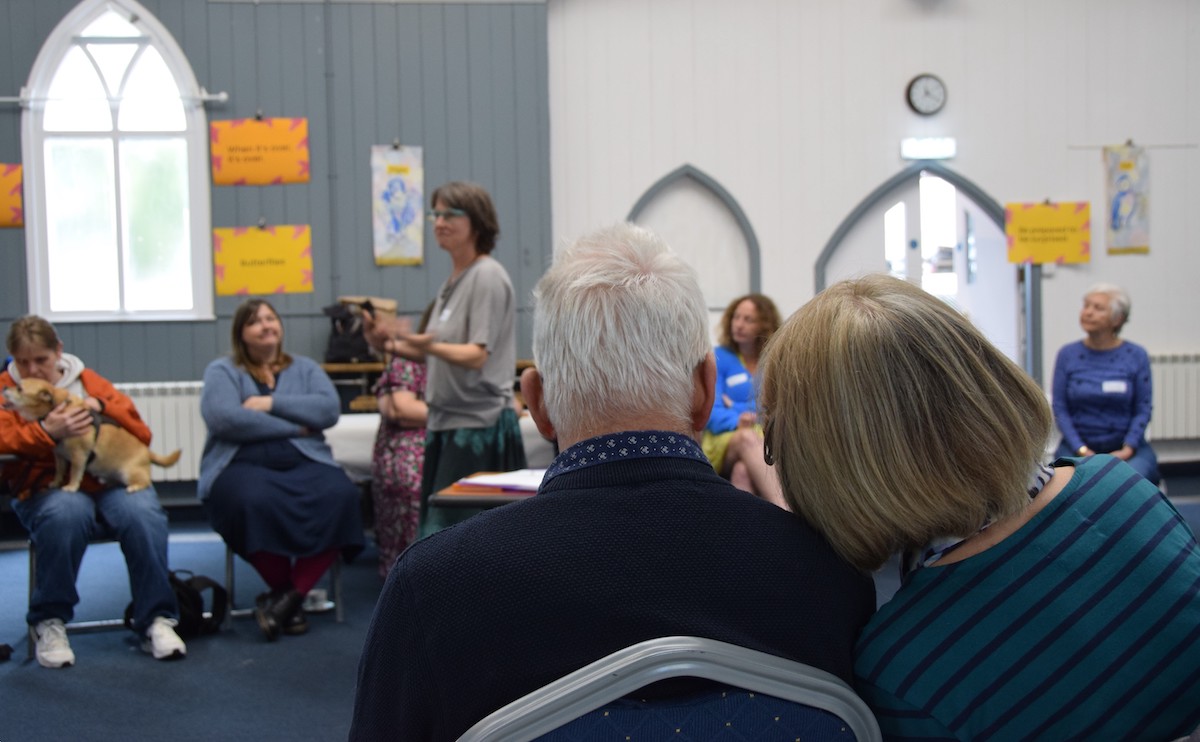 image credit: Miriam Sim
In this article, we share the findings from our Open Forum events and discuss what we’ve learned from the process, including its impact on our developing manifesto for cultural change for people with dementia. Led by our Open Forum participants, we explore insights into connection and community, creativity and cultural participation, and identity, agency and meaning-making. In this way, we build on our previous article, in which we used the latest published research with our comprehensive evaluation data to elucidate the relationship between our approach and the impact we have on our community. These articles serve to open up our learning and practice, articulating what makes our approach different, and how we can widen our impact by sharing our principles beyond our own creative programme.
Open Forums
Since June 2024, we have been developing a series of pilot Open Forum events, in which we use adapted Open Space Technology (OST) to gather views and ideas from a wide range of stakeholders while centring the voices of people with dementia. These events emerged as part of our mission to strengthen the ways in which people living with dementia, including those with complex disabilities, are involved at the heart of our organisation, responding to a need to catalyse a wider sense of community power and activism within the local dementia community, and to enrich our evaluation data using our trademark multimodal arts approaches. From the findings gathered here, we offer our colleagues in the arts, in health and social care, and academia, insight into the development of our manifesto for cultural change for people with dementia.
Our Open Forum events unfolded in three stages. From our first event, held in Hythe, we tested the opportunities and limitations of adapting OST for people living with dementia, especially so that those for whom traditional meetings are inaccessible are able to participate as fully as they wish. We found that the openness of this approach could become overwhelming for our community, and that anchoring this openness with the addition of music and creative worldbuilding was in some ways successful in tempering this by creating space for non-verbal contributions.
Building on these findings, we approached our second Open Forum with a more focussed area of inquiry, which emerged from discussions at the first event. Specifically, we focussed on access to culture for people living with and affected by dementia. By using a series of creative games, while remaining in the spirit of the principles of OST, Bright Shadow artists Lucy Stockton-Smith and David Leahy could collaborate with our participants to co-create bold plans for our collective cultural lives. By adapting OST in this way, we found we could develop a village noticeboard brimming with ideas for what our community understands culture to be, the sustenance they drew from it in the past, and what they would like it to look like in the future.
Developing from the village noticeboard and the successes we have seen when connecting all four Zest groups, whether in large collaborative gatherings or through projects linking multiple groups, we decided to embed our third Open Forum into Zest sessions themselves. This allowed us to harness the creative energy of each group to develop tangible ideas for the future of our creative and advocacy programmes, and for what access to a cultural life means for people with dementia more broadly. By bringing the findings from our initial events to the familiarity of our Zest settings, our participants could build on this knowledge with creative confidence supported by the unique relationships between our participants, our artists and our Session Coordinators.
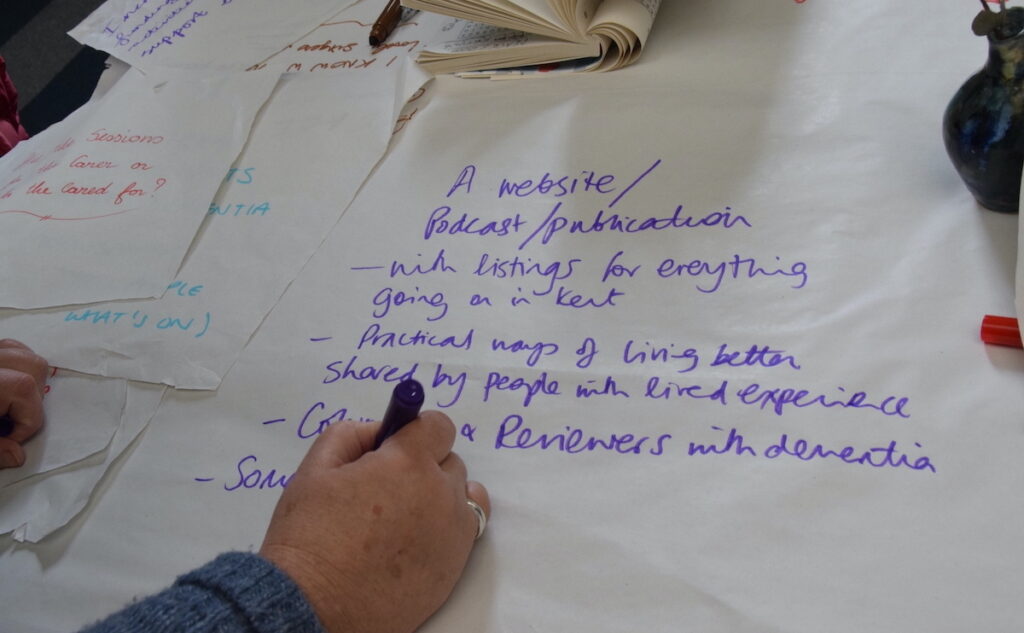
These events allowed us to gather a wealth of qualitative data from nearly 700 responses. Responses were recorded through writing, including scribing for other participants where appropriate, through photography and video, and through drawing and poetry. We went on to conduct a thematic analysis of these responses, identifying patterns from our participants’ contributions that informed our focus on connection and community, creativity and cultural participation, and identity, agency and meaning-making. As we examine these findings, we invite readers to reflect on the ways in which playing a full role in cultural life can have a profound impact on wider societal attitudes towards living with dementia, the care of people with dementia and the strength of our communities.
Findings
Connection and community
Connection and community emerged as a strong theme across our pilot Open Forum events, both through 115 responses explicitly mentioning it and through conversations shared over tea and cake. This is significant because our participants often tell us that they feel forgotten, overlooked and dismissed – both as they go about their day-to-day lives and also in medical contexts. When these discussions were framed by our creative, OST-inspired context, our participants suggested that by infusing these day-to-day interactions with creativity, they could become opportunities for positive connections: “the antidote to people-less tills.”
Just as Zest is the “highlight of our week”, as one participant told us, so these creative interactions build positive moments into our days, while also recognising collaboration with people living with dementia as an opportunity to create – to innovate. Such artistic interventions might include:
- Artist-led creative training equipping frontline staff across retail, transport, health, social care and hospitality with creative improvisational skills to build an inclusive, empowering and positive community through day-to-day interactions
- Artworks created by people living with dementia – from poetry to sculpture, photography to textiles – adorning spaces that might otherwise feel unwelcoming, challenging perceptions of people living with dementia
- Ambitious, high quality co-created publications offered throughout the community and online, including in GP surgeries and hospital waiting rooms, creating a portal into a dementia-positive community led by people living with dementia
In this way, making connections and building community is recognised as a creative act and an opportunity to use artistic interventions to transform small interactions into positive, life-affirming acts of connection. These small creative interventions not only enrich participants’ day-to-day lives but also contribute to a broader dementia-positive culture.
Culture in motion
Forms of culture based on movement – be that sports, dance, play or walking in nature – were the most commonly discussed theme by our participants, with 159 responses (23%) referencing them. We found that sports in particular showed a strong contrast between past enjoyment and present engagement. Of the 89 responses about sport, 51% related to past enjoyment, 29% described present participation, and 20% expressed a wish to take part in the future. This suggests that our community faces barriers to accessing sports activities in the here and now, which is significant as sport not only offers opportunities to move our bodies but also to work as a team, embrace physical challenges and develop coordination and skill.
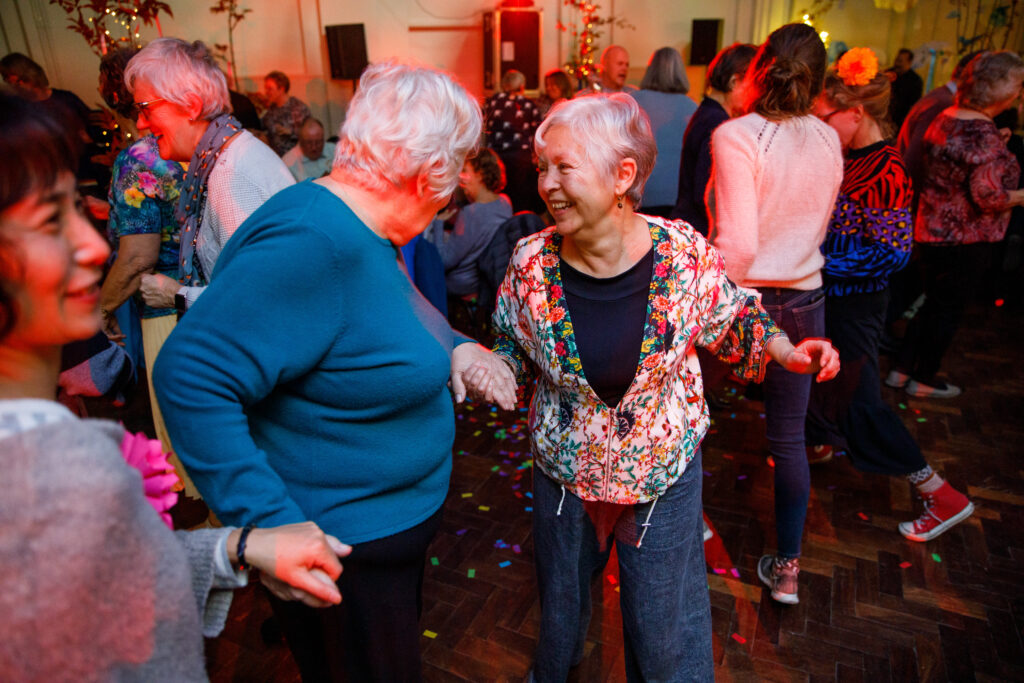
By contrast, dancing is a source of joy for many of our participants in the present moment, with nearly 61% of 33 responses mentioning dance focussing on present participation and just 36% on past enjoyment. Being outdoors and in nature showed an increase in enjoyment in the present compared with the past, with 71% of the 17 responses about being in nature focussing on enjoying the great outdoors now, and 24% the past. This suggests that these may offer an alternative and more readily available outlet for our human need for movement, while also highlighting the importance of fostering the sense of togetherness inculcated by team sports.
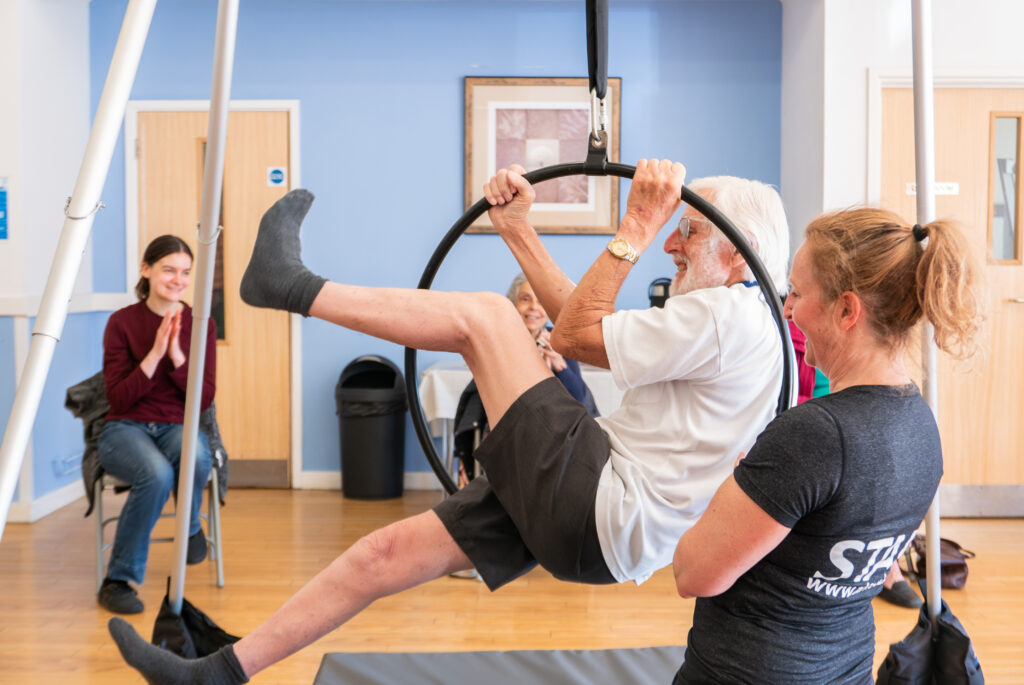
One participant in the third phase of our Open Forums, which were embedded in Zest, spoke memorably about how he “used to enjoy sailing”, telling us about how it fosters a sense of “independence using the wind.” By embedding an expectation of supported independence as well as creative physical challenge into Zest sessions, our participants find a similar sense of confidence and fulfilment through movement. As one participant told us at the end of a session with professional hip hop artists, “I feel so worn out from doing so much dancing, but in a good way.” Through our pioneering approach to dementia arts experiences, we reimagine the challenge of sports through physical creativity, amplifying the thrill of dancing and the importance of being in nature: be that through aerial yoga or hip hop, clowning or dancing our way through the world’s gardens.
In this way, by incorporating movement-based art forms into group creative sessions, we can weave some of the elements of playing sports – togetherness, challenge, coordination and skill – back into our community’s present experiences. What’s more, by approaching movement through Bright Shadow’s unique methodology, it becomes more than a vehicle for maintaining physical fitness: rather, participants are empowered to develop movement as a creative language. This approach develops physical and community benefits alongside creative ambition and artistic integrity. On a broader scale, these Open Forum findings enable us to recognise culture in motion as an essential element of a dementia-positive society, embracing opportunities for movement and challenging preconceptions about living with dementia.
Making culture
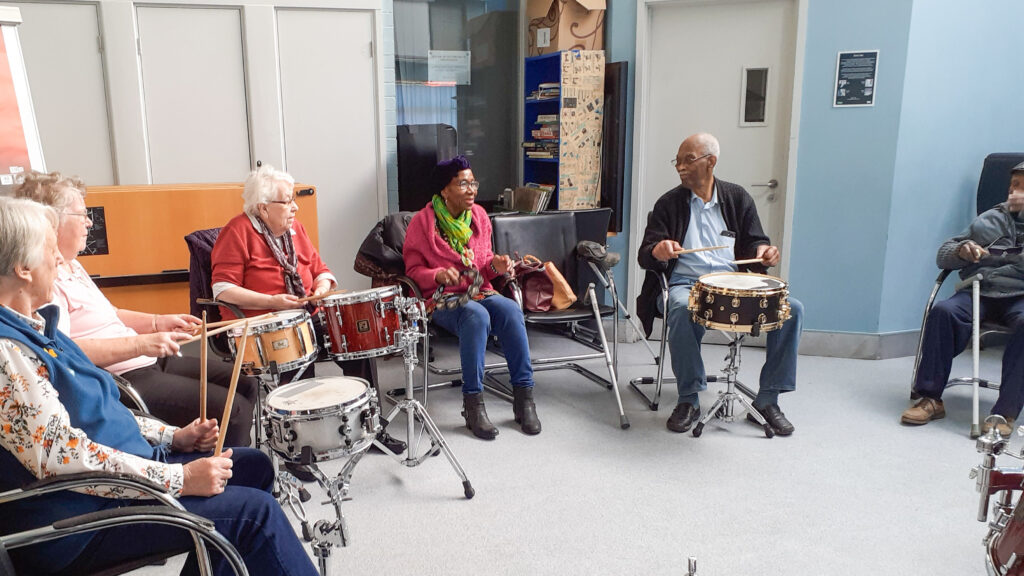
Creativity, making and imagination are of central importance to our community’s lives. 155 responses (22%) spoke about making their own art, with 31% mentioning music, 28% crafts, 21% imagination and inventing, 17% drawing and painting, and 3% photography. Indeed, these active forms of culture, movement and making – discussed here and in the previous section – are the two most frequently discussed themes throughout our pilot Open Forums, together making up 45% of total responses. This emphasises the importance of recognising people living with and affected by dementia as cultural leaders rather than only passive recipients of cultural activities.
As one participant put it, for our community, producing culture together offers all-important “permission to be playful, creative, confident”. Many responses endorsed the value of our multi-art form approach, emphasising a love of all forms of culture, which for one member of the group encompassed everything from “moving and dancing and laughing” to “stories and reading and writing.” Making music was of particular importance to our participants, who demand agency when engaging with cultural offerings: “not bloody Vera Lynn!”
Our participants spend time making beyond the creative opportunities they engage with out of the home, something we explore in more detail below. For our participants, challenging ourselves, taking on creative roles in our community and making our mark on the world through culture are not luxuries. These are, as one member of our Open Forums put it, “important for life – like medicine.”
Culture at home
The home emerged as an important site of creativity for our participants, again suggesting the value of creativity in the day-to-day lives of people living with and affected by dementia. 88 (13%) of total responses related to culture at home, encompassing reading, writing and poetry (32%), games and puzzles (23%), gardening (22%), radio, audiobooks and podcasts (9%) and homemaking (3%). The importance for our community of consuming and creating culture at home reveals culture’s permeation of every facet of our lives, and the boundless opportunities for creative interventions to improve our lives.
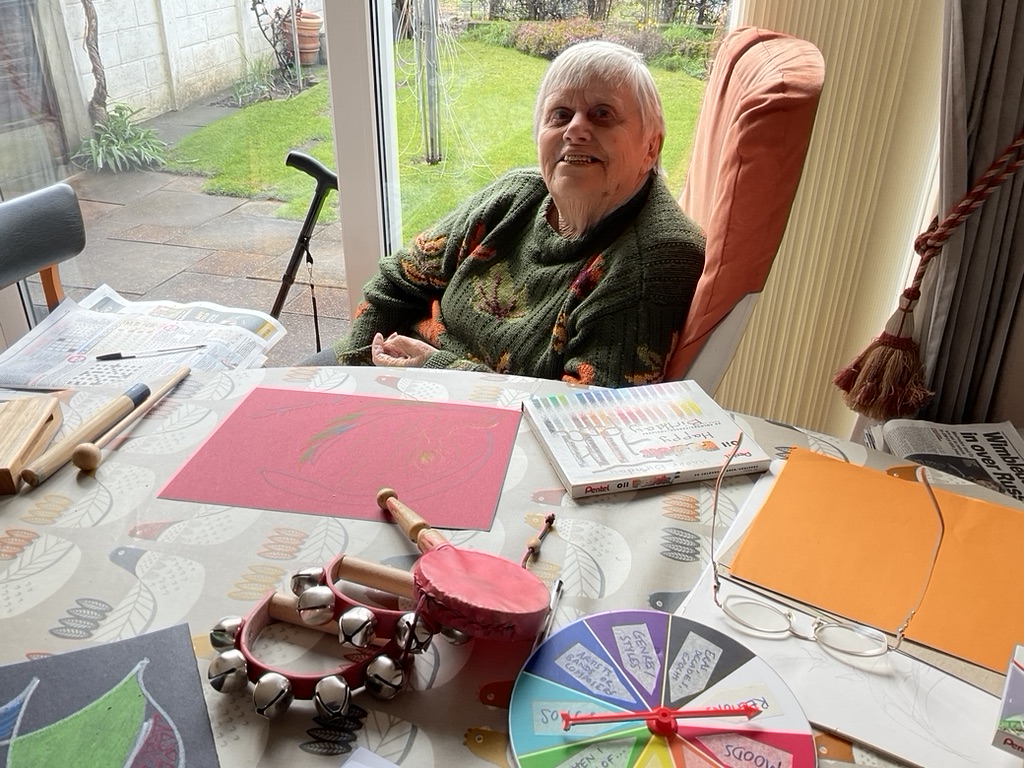
Furthermore, home is the place from which our relationships with one another can flourish, emphasising the importance of the relationship between culture, connection and community to our participants. Whether “doing a jigsaw and listening to an audio book”, “playing family games”, or “playing in the mud in the garden”, the sense of playfulness available in our private spheres enables us to create beautiful and poignant things from life’s minutiae.
Through our Zest at Home programme, we use the intimacy and possibility of the home environment to forge a renewed sense of creativity with people who are unable to participate in our group offerings due to crisis, isolation or a sudden loss of communication skills. Participants are partnered with our expert artistic practitioners to create extraordinary artworks together in their own home. Stories from this programme include Bright Shadow artist David Leahy using musical improvisation in a moment of profound crisis to reactivate poetry written by a Zest at Home participant, illuminating the importance of the home as a cultural space where creativity can come to life.
In this way, recognising creativity in the home environment, alongside introducing new or different artforms, opens up possibilities for cultural nourishment in moments where possibility might otherwise seem closed down. By appreciating the home as a cultural space, we can expand the scope of our creative interventions.
Cultural encounters
As well as creating culture, our Open Forum participants shared with us a rich array of cultural encounters they enjoy in the present moment, as well as many experiences they used to enjoy and long to enjoy still. 104 responses (15%) discussed cultural encounters, comprising travel (48%), theatre and cinema (27%), food and drink (23%), and visiting galleries (2%). As with Culture in Motion above, many participants spoke of enjoying activities like travel in the past, with less being able to access these cultural encounters in the present moment.
Participants spoke of “joyful holidays” with “blue skies”, explaining their important role in “keeping spirits up”. Others explained barriers to accessing culture through travel, explaining they’d “like to enjoy it but can’t any more”. Some spoke of specific places and experiences – like visiting Egypt, going to festivals, or riding on the Orient Express – they long to encounter. These barriers can represent opportunities for creative interventions to facilitate our community’s need to engage with culture by overcoming barriers to participation. Indeed, from all these experiences, we can understand a sense of joy in adventure and delight in escapism through cultural encounters in the world around us.
In this vein, visiting cafés and restaurants – enjoying coffee or “nice curry!” – were also important cultural experiences for our participants, who also spoke of the “delight” that can be found in works of art. Our creative programme is often led by our participants’ passion for cultural encounters, including through Zest sessions taking travel and other cultures as their theme, and through our successful Armchair Travel Agents workshops we undertook together during the COVID-19 lockdowns. The value of these everyday experiences is important to hold in mind when designing creative interventions that work towards our dementia-positive culture.
Identity, advocacy and meaning-making
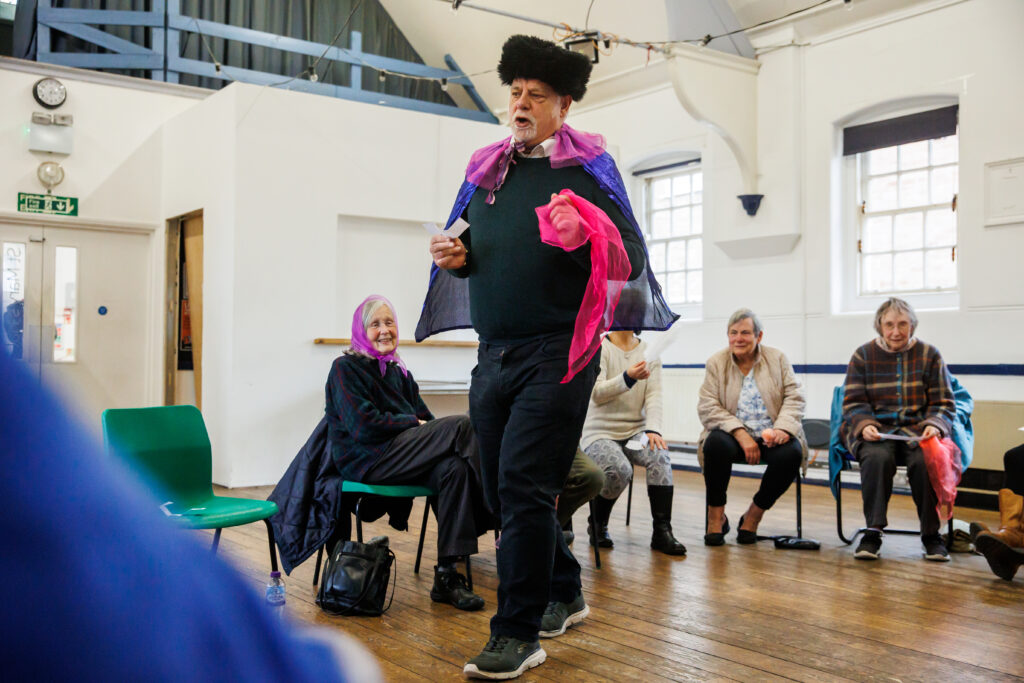
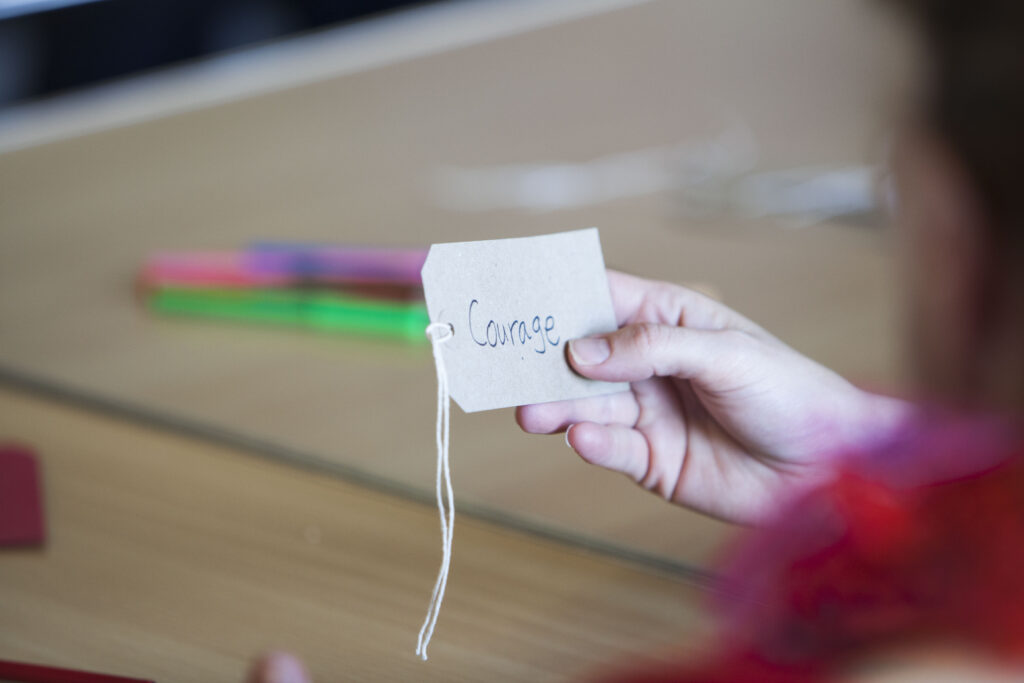
Identity, advocacy and meaning-making were important themes for our Open Forum participants, revealing the importance of creativity in empowering our community’s sense of purpose. These themes appeared in 12% of total written and creative responses, and they also arose through informal conversations shared around sessions. Written responses encompassed discussions of fashion and beauty (23%), autonomy and choice (21%), religion and spirituality (21%), advocacy (11%), time for oneself (9%) and health and wellbeing (7%). As with Connection and Community above, these themes also infused our other conversations about creativity and culture throughout our Open Forums.
Participants described the importance of fashion and beauty – including hats, make up, jewellery, shopping, shoes and hairdressing – especially as something they enjoy in the present, although for some these were aspects of culture they used to enjoy. This ability to take control of our appearance in the world around us, was reflected also in the desire for people living with dementia to take up, and be recognised for, influential roles in the community. We also see this in the success of, for example, the NHS Dementia Envoys programme. Bright Shadow has long recognised the importance of celebrating the role of people with dementia in our community, including most recently by appointing two trustees living with dementia to our board, building on other previous models of participant advisors.
The groups identified opportunities to expand such roles, including by using “experts by experience in training social care workers, social workers, care managers” or “involving and employing people with dementia to enrich communities.” These findings are echoed in broader evidence from Think Local Act Personal, whose recent report emphasises the importance of self-determination, community recognition and opportunities for personal growth to people living with dementia.
Through both our advocacy and our creative programmes, we strive to support and nourish this sense of purpose in our community, creating opportunities to “try things we’ve not had the opportunity to do before” in environments which are “neither too safe nor too uncomfortable” – meeting everybody in our unique “learning zone or edge”, as one Open Forum participant put it. In this way, people with dementia are “seen as individuals with a skillset that does not vanish”, forging “meaningful connections” through “meaningful roles”.
Conclusion and next steps
Through our Open Forums, we learnt that culture in all its forms matters profoundly for people living with and affected by dementia. From making movement together through sport, dance or walking in nature, to making music, poetry and art; sharing food and drink together or travelling the world through our imaginations, our participants have made it clear that creativity and culture are fundamental to our wellbeing. They are, as one participant told us, “important for life – like medicine”.
Across nearly 700 data points, the recurring themes of connection and community, movement, making, creativity at home, cultural encounters and identity, autonomy and meaning-making all remind us that culture is a powerful force in strengthening relationships, creating purpose, and challenging societally- and self-imposed limits placed on people living with dementia.
Our learnings from this process are incredibly valuable for Bright Shadow’s own programmes. We also believe in their potential to inform a wider cultural shift, through their distilment into a creative manifesto for cultural change. By sharing our approach in this way – an approach rooted in creative equality, artistic ambition and growth over loss – we aim to spark collaboration across arts, health and social care.
These findings also underline the urgent need to recognise:
- Our deep desire for connection, and culture’s role as its catalyst
- The importance of creativity and the value of the multi-art form approach
- Artistic interventions as a model for supporting relationships by transforming day-to-day interactions
As we continue on this journey, we will continue to refine our methodology, develop our manifesto for cultural change as it emerges from the voices of our participants, and continue to share what we’ve learnt, so that together we can expand opportunities for people living with dementia to engage with and lead cultural life. In this way, we can begin to build our dementia-positive culture together.
This article is part of Bright Shadow’s Living Dementia Differently series, exploring creativity, wellbeing and cultural change. Read the full series and discover our latest project, Bright Times, here.
Download our latest insights: